The hidden cost of building an indie author business alongside another career
It's not just time. It's the mental load of running two businesses in parallel.

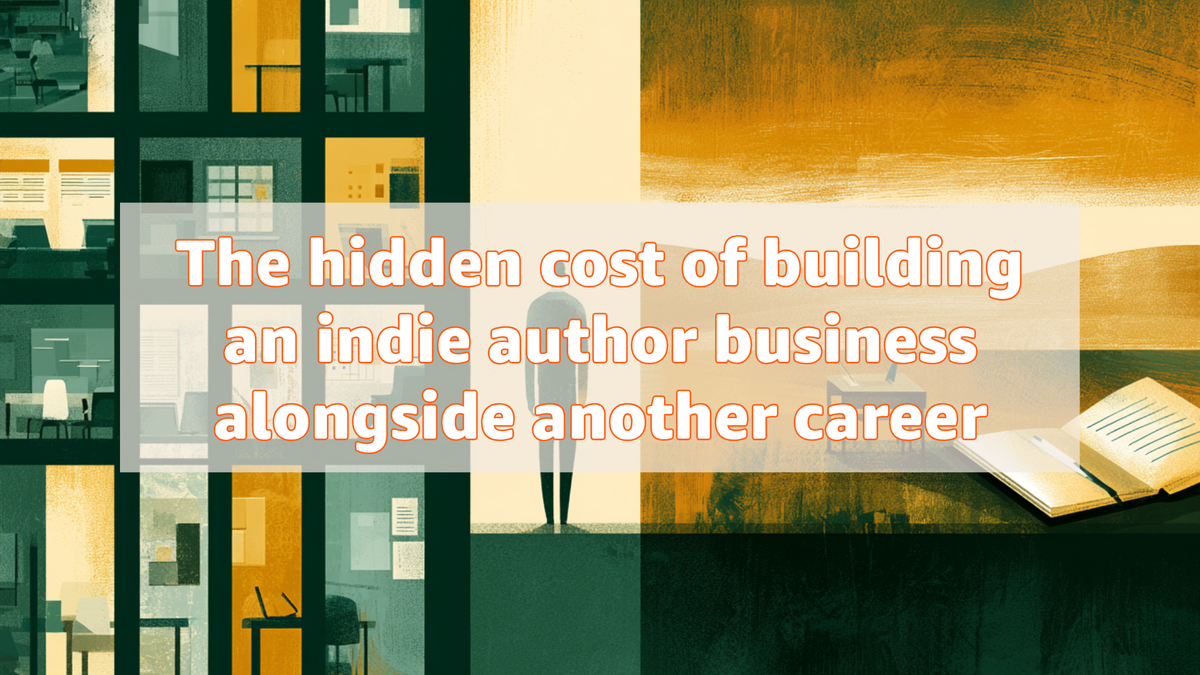
Most indie author advice assumes you are either writing full time or treating it as a casual hobby. The middle ground, where you are running an indie author business properly while also working full time as something else, gets talked about far less. And it is the position most early-stage indie authors actually find themselves in.
I have been doing this for several years now. Four days a week consulting in change management, organisational design, and fractional leadership for digital teams. The rest of the time split between writing, running the publishing business, and the rest of my life. I want to write honestly about what that actually costs, because I think it is one of the most underestimated parts of starting an indie author career.
The time cost is the obvious one. It is also the smaller one.
If you work full time, you already know there are limits on the hours available. The maths is simple. You write in the gaps. Early mornings, evenings, train journeys, weekends, lunch breaks. You learn to make those gaps productive.
I write on the train when I commute to client offices. I write in cafés when I arrive early. I edit between 5 and 6:30 in the evening on days I am working from home, before switching to making dinner. I do publishing business work in fragments throughout the week. Weekends are split between writing, business activities, and the rest of my life.
It works. You can build a sustainable writing practice around a full-time job. Five novels are proof of that for me. But the time itself is not the hardest part. The harder part is what runs in the background.
The real cost is the mental load of running two businesses in parallel.
Consulting and indie publishing are completely different modes of work. Consulting is reactive and relational. You are responding to client problems, leading teams, navigating organisational dynamics, holding multiple stakeholders in your head simultaneously. The mental work is dense and externally driven.
Writing is the opposite. It is internal, sustained, and requires a kind of quietness that is hard to access when the consulting brain is still running. Switching from one to the other is not like changing tasks. It is like changing operating systems.
On days when I am working from home, I find the transition manageable. I can close the consulting laptop, walk away from my desk for ten minutes, and come back into writing mode reasonably cleanly. On days when I am at client offices, the transition is harder. The commute helps, the train becomes a kind of decompression chamber, but the consulting brain takes longer to quiet down when I have spent a full day in someone else’s environment with someone else’s problems.
This is the hidden cost. It is not just that you have less time. It is that the time you do have is fragmented across two completely different ways of thinking, and switching between them takes energy that does not show up on any time sheet.
What helps, what doesn’t, and what I’ve learned to do
A few things have helped over the years.
Weekly targets, not daily targets. I set targets for the week rather than the day. This gives me seven days to hit them rather than seven separate days to fail. Some days I am under target. On those days I push harder later in the week to make up the deficit. This single change has done more for my output than anything else, because it removes the pressure to perform every day and accepts that some days the consulting work will dominate.
Consolidating the publishing business into a single day. I am moving toward doing all of the publishing business work, the social media, the ads, the accounting, the marketing, the research, the Substack writing, on one day a week. The principle is simple. Context switching is the most expensive cost. If I can consolidate the business work into a single concentrated slot, the other six days are free for writing, consulting, and home life without the publishing business interrupting them.
A structured system for tracking what I am doing. I use Notion to organise everything. I have a Kanban backlog with views for today, this week, daily, weekly, monthly, quarterly, and annually. Every task is tagged with one of three categories: Personal, Consulting, or Publishing. Each Sunday I sit down and plan the week ahead. Each morning I pick the specific tasks for the day. This is not about productivity for its own sake. It is about being able to see, in one place, where my time and attention are actually going across all three areas of my life, and noticing when one is consuming the others.
Protecting writing time consciously rather than hoping it survives. Writing time is the first thing that gets eaten when consulting work intensifies or home life gets busy. The only way I have found to protect it is to be deliberate about it. Block the time, set the target, treat it as a real commitment rather than something I will get to if I have the energy.
What I would tell anyone starting this
If you are thinking about building an indie author business alongside another career, here are the things I wish someone had told me earlier.
The time cost is manageable. The mental cost is the one that will surprise you. Plan for that, not just for the hours.
Some days you will write and some days you will not. That is fine. Set weekly targets and accept that the rhythm will be uneven.
Consolidate where you can. Two hours of focused publishing work in one block beats two hours scattered across the week, because the context switching is what drains you, not the work itself.
Get a system for tracking everything. Notion, a notebook, a spreadsheet, whatever works for you. You need to be able to see where your time is going across all parts of your life, or one of them will quietly take over.
Accept that this is harder than the people doing it full time will tell you, and harder than the people treating it as a hobby will admit. Building a real business while also doing another job is genuinely demanding work. You will need to be honest with yourself about what you can sustain.
And finally, the cost is worth it if the writing matters to you. I have been doing this for years now and I would not trade it. The hidden cost is real. So is what you build on the other side of it.
Why subscribe to Indie Author Notes?
Subscribe free to get regular dispatches from The Journey, Craft or The Business. Or go paid for the full picture, the unfiltered account of what building an indie author business actually looks like. Plus access to any templates or resources in the Resources section.