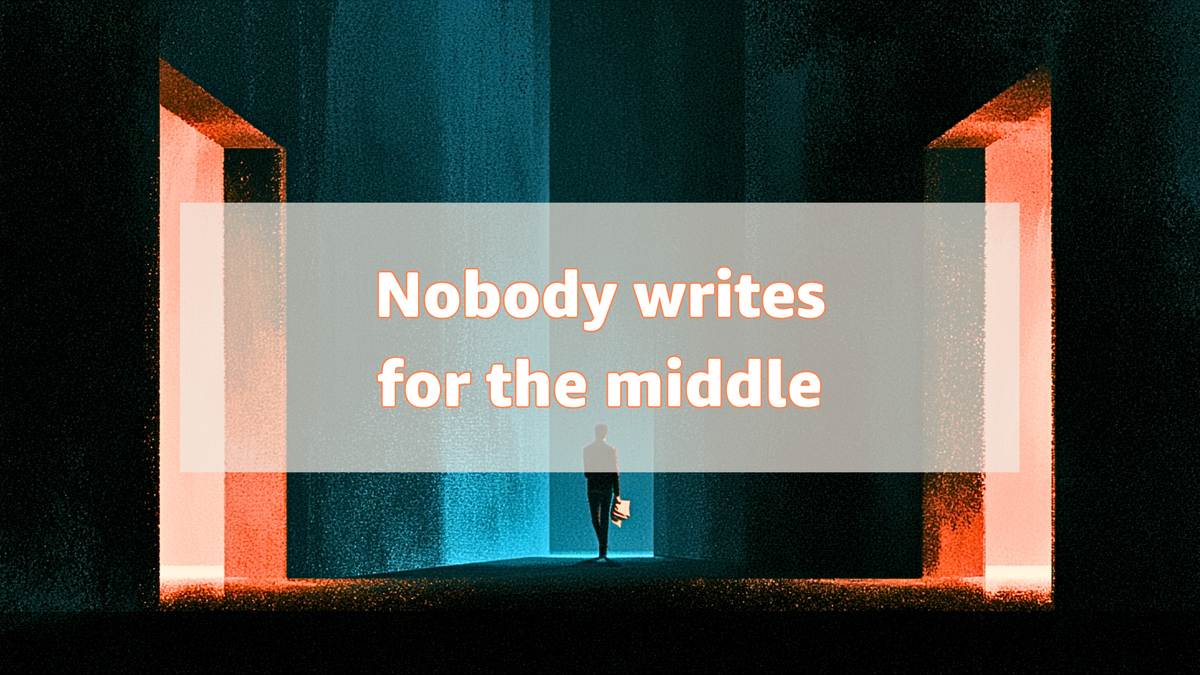
Nobody writes for the middle

At Self-Publishing Show Live (SPS) in London this year (2026), someone in the audience asked a question I've been considering for months.
They wanted to know how you juggle it. All of it. The writing, the ads, social media, mailing lists, cover design, the metadata, the accounting, alongside the full-time day job. The full weight of running a one-person publishing business while also, somehow, producing books, and working elsewhere.
The seven-figure author on the panel answered without hesitating.
"You get your people to do it."
I don't think they were being unkind to the audience member. I think it was simply their truth. They have people. That's what solving the problem looks like from where they're standing, and it would have been dishonest to pretend otherwise.
But as I looked around the room, I guessed that most of us didn't have people. We had a spreadsheet and a Tuesday evening or an early Sunday morning.
That was the moment it landed, though it had been forming since the previous year's SPS Live. I'd sat through a full day of talks and slowly realized that almost every one of them was pitched at one of two audiences: first-time and not-yet-published authors, and people running seven-figure operations. Launch your first book. Scale your ad spend. Structure your team.
Between those two there's a long, unglamorous stretch that nobody had anything to say about. I'd wandered into it without noticing. I suspect most working indie authors are in it right now.
The loop
There are two pieces of advice you get in the middle. They're both good advice, and together they form a closed circle.
The first is just write the next book. This is true. Books sell books, read-through is the engine, and nothing you do to a backlist of two will outperform having a backlist of eight. It requires time.
The second is get people to help you. Also true. You cannot do the writing and the marketing and the admin and the ads at the standard that all four deserve. It requires money.
The money comes from books. And the books require time. The time is currently occupied by the full-time job that's paying for the covers and the editing in the first place. Every exit from the loop is behind a door the loop itself holds shut.
Neither end of the spectrum has to solve this. Before your first book you don't have the problem yet: you have a manuscript and a great deal to learn. At seven figures you've solved it with money. The middle is the only place the loop is active, and it's the one place nobody writes about.
Why nobody writes about it
Two reasons, I think.
The first is memory. People who "make it" are describing it from the far side, years later, with the loose threads all tidied up. Their advice is real, but it's been watered down. They no longer remember what it was like to be uncertain, stuck, overwhelmed.
The second is that the middle doesn't sell. There's no system in it. You can package how to publish your first book, and you can package how to scale to six figures, because both come with a promise. The middle comes with no promise at all. It's a stretch of unglamorous, uncertain work with no guaranteed outcome, and is therefore very difficult to put a price on.
What it actually looks like
Here's the honest essence of it.
You work seven days a week. Not because you're heroic. Because the arithmetic requires it. I consult Monday to Friday, nine to five, for clients who deserve my full attention and get it. Writing happens in the margins: early mornings, evenings, weekends, any hour I can steal away.
Meanwhile the social feeds have to keep firing. Threads, Instagram, Facebook, TikTok. Ads running, monitored, and analyzed. Word counts I'm not hitting, and the stress and anxiety that creates. A growing following clamoring for the next book in the series. An Amazon page that needs auditing. A website that needs updating. BookFunnel, Bookvault, BookBub, Shopify: platforms to research, price, decide on. Benchmarking against other authors in my genre. Research to read, podcasts to listen to, courses, workshops, conferences.
And a home. A partner. Meals to cook. A gym I go to. Tidying that doesn't do itself. A never-ending cycle of activity.
None of that appears in the beginner content, because it would be discouraging. None of it appears in the seven-figure content, because it's been delegated to their "people." It's the actual daily condition of most working indie authors in the middle that I know, and it's essentially undocumented. It's the liminal desert nearly every writer wanders through on their journey from first-time to seven figure success (or not).
The number I watch
I've stopped watching most of the numbers people talk about. The one I watch is margin.
Straight cash: what I put in for editing, cover design and audiobook narration, against what comes back. Right now that runs at about 28% a month.
Here's the honest part. That figure doesn't count my time. Not one hour of it. If I costed my labor into it at anything like my consulting rate, the number would be deeply negative and I'd be having a different conversation with myself.
I'm not being evasive about that. It's precisely what the middle is: a business that has become profitable in cash and is nowhere near profitable in hours. 28% is not enough to go full-time on. It's enough to say the direction is right. Those are two different claims and I intend to keep them separate.
The third way
If the loop is real, then the answer isn't the first piece of advice or the second one. It's a third thing nobody was talking about at SPS: buying the time back.
Tools. Process. Automation. AI agents doing the work a seven-figure author would hand to a person. Not because it's clever, but because it's the only lever available to someone with more problems than money.
That's a large part of what this site will be about, and I'm going to show it with real figures: what I spent, what it returned, how long it took, what broke.
What this is
I'm writing the thing I wanted to read and couldn't find.
The distinction I care about is between someone who is there and someone who has been there. Both have value. But only one of them still remembers the texture (because they are living it, not remembering it nostalgically).
So: successes and failures, in equal measure. Real numbers, including the unflattering ones. No system for sale, and no promise that if you do what I did you'll get what I get, because I don't yet know what I'll get.
Which is the last honest thing, and the one I hesitated most over.
The journey is ugly and uncertain and there is no predetermined outcome. I have a vision. I have goals. I'll work hard at them. None of that guarantees anything, including success.
I'll keep writing, keep learning, keep experimenting, keep going until I make it.
Or I don't.